Monday, March 23, 2026

Everybody's Crazy

 Here's another article about our ability to overcome things.  While this is meant as an explanation of how resilient people are generally  and how this directly affects their mental health I find a lot of relevance to how we recover or flounder or die from alcoholism.  My A.A. protege and I have been trying to get in touch with the suddenly unresponsive new woman and having no success for a couple of days, never a good sign.  Then, today, the new woman calls me - explaining that she has been working and hates texting, excuses, excuses, how we love excuses - and left me floundering as to how to explain the insanity of her behavior.  Too busy with work and kids and an increasingly frustrated fiance to get some medical health for the shakes she gets when she tries to quit drinking cold turkey while realizing she's on the razor's edge of losing her job and kids and fiance but unable to bridge that gap of insane thinking to pick one or the other.  It's heartbreaking.  I literally didn't know what to say.  I can only stress that as a non-professional I think she needs some medical help.

In 1966, a developmental psychologist named Diana Baumrind published a study that would change how we think about parenting. Working out of the University of California, Berkeley, she identified three distinct styles: authoritarian, authoritative, and permissive. Her research was groundbreaking. But here’s the thing that always strikes me about that timing.

My dad grew up in the 1960s, working-class, outside Manchester. His father worked in a factory and was involved in the union. His mother worked in retail. Nobody in that household was sitting around discussing feelings over dinner. What they discussed was politics, work, and whether things were fair or not.

Dad didn’t talk much about his childhood in sentimental terms. But the stories he did tell had a common thread. He walked to school alone. He sorted out his own problems. If he got into a scrap with another kid, no parent was phoning anyone. He dealt with it, or he didn’t, and either way he showed up the next day.  That wasn’t unusual. It was just what childhood looked like.

What psychologists now recognise is that this kind of unsupervised, unstructured experience was quietly building something. Research psychologist Peter Gray, who has spent his career studying free play at Boston College, has argued that the contraction of children’s independent activity since the 1960s has made them markedly less resilient. Over several decades, as children’s freedom to play and explore without adult intervention declined, rates of anxiety, depression, and suicide among young people steadily climbed.

The uncomfortable conclusion? The very thing that felt like neglect was functioning as emotional training.  There’s a concept in psychology called distress tolerance. It’s exactly what it sounds like: the ability to feel awful and not need it to stop immediately. To sit with discomfort without being destroyed by it.  Children raised in the 1960s got daily practice in this without anyone calling it that. They waited for things. If they wanted to watch a programme, they had to be there when it aired. If they wanted something from a shop, they saved for it. If they were bored, tough. Nobody was handing them a screen.

As Gray explained, play is how children learn to direct their own activities, negotiate with peers, and deal with minor bullying. When adults constantly supervise and intervene, children never get the chance to develop those skills for themselves. The result, he argues, is that the first real emotional storms don’t arrive until eighteen instead of eight. And by then, the window for building certain coping mechanisms has narrowed considerably.

I think about my dad’s generation and the way they handled setbacks. Redundancies. Health scares. The slow erosion of the industries their towns were built on. They weren’t immune to pain. But they had this ballast, this underlying steadiness, that came from decades of small, unrescued difficulties stacking up into something solid.

Here’s where the data gets really striking.  Gray’s research highlights work by psychologist Jean Twenge, who analysed decades of data on something called the “locus of control.” This measures whether someone believes they have control over their own life (internal) or whether they feel controlled by outside forces (external).

Twenge found that between 1960 and 2002, average scores among young people shifted dramatically toward the external end of the scale. By 2002, the average young person was more externally oriented than eighty percent of young people in the 1960s. And that shift tracked almost perfectly with the rise in anxiety.  In other words, the generation raised in the 1960s didn’t just feel tougher. They had a fundamentally different relationship with their own agency. They believed they could influence what happened to them. And that belief, according to the research, is one of the strongest buffers against mental illness.

My grandparents lived through the war, and their stories made history feel like something that happened to real people, not just textbook stuff. That perspective filtered down. You didn’t sit around feeling sorry for yourself because you’d grown up hearing about people who’d survived actual catastrophes through sheer will and stubbornness. It recalibrated what counted as a crisis.

None of this means we should go back to telling children to toughen up. The 1960s produced resilience, but it also produced a generation that often couldn’t talk about what was hurting them. Emotional suppression was the norm. Mental health was stigmatised. There were blind spots that did real harm.

I’ve mentioned this before but I think one of the most important things I’ve learned from reading psychology and history is that you can hold two truths at once. The 1960s got some things right by accident. It also got some things badly wrong on purpose.

But the overcorrection is worth thinking about.  Play is how children develop the character traits needed to become independent adults. When we protect them from every bump, we’re not building confidence. We’re quietly communicating that they can’t handle things on their own.

The parenting culture of the 1960s didn’t intend to build emotional resilience. Parents were just busy. They were stretched thin. They were following a culture that expected children to handle a fair amount on their own. But in the gap between needing something and getting it, between facing a problem and finding help, something important was being forged.

I lost my dad a few years ago. And in the weeks and months that followed, I found myself thinking a lot about the kind of person he was. Steady. Unflappable in ways that sometimes frustrated me when I was younger but that I came to admire deeply as I got older. a therapist. He didn’t journal. He didn’t meditate. He just had this core of something that held him together through redundancies, through my parents’ difficult years, through watching his own hometown change beyond recognition as the jobs disappeared.

Was some of that problematic? Probably. He could have talked more. He could have let people in more. But the underlying steadiness was real, and it came from somewhere. It came from a childhood where nobody rescued you from discomfort because nobody thought discomfort was something you needed rescuing from.

Psychologists aren’t suggesting we recreate the 1960s. What they’re suggesting is something more nuanced: that we’ve removed so much friction from modern life, especially from childhood, that we’ve accidentally eliminated the raw material resilience is built from.

The generation raised in that era didn’t choose to be tough. They were shaped by a world that didn’t consider their emotional comfort a priority. And paradoxically, that lack of comfort gave them something that no amount of well-meaning intervention can easily replicate.

Resilience isn’t a personality trait. It’s a skill, and like all skills, it needs to be practised. The 1960s provided that practice automatically, woven into the fabric of daily life. Today, we have to be more intentional about it.

That doesn’t mean being harsh with ourselves or our children. It means resisting the urge to smooth every rough edge. It means letting small problems run their course. It means understanding that the ability to sit with discomfort, to tolerate uncertainty, to believe you can handle what comes next, these things aren’t born. They’re built.

And they’re built, more often than not, in the moments when no one is coming to help.
Any Advice? From Me?

I have an update on the young woman who cuts my hair and has struggled with alcohol in her past . . . and in her present as it turns out.  Repeating myself I am still surprised at how many people can relate - either personally or concerning a loved one - when I share about my alcoholism and my recovery.  This naked admission of a checkered past isn't for everyone - isn't appropriate for everyone - but it fits into my lifestyle nicely, partly, I think, because I enjoy the shock value of what I'm revealing, this kindly gray-haired grandpa figure.  Anyway, I was delighted to get a phone call and a text from her asking if I could recommend a sponsor.  I encouraged her to attend my meeting in person - I think face to face works best when you're new - but also passed her phone number on to a couple of young women in the meeting that I thought would be a good fit and that I knew were willing to reach out.  One of them is about her age, also has two small children, and works in the same field.  These two hit it off and the new woman actually showed up at the meeting.  I faded into the background.

Later in the day I checked in with my friend and got a lot more information about the new woman than she had revealed to me.  Granted, I was talking to her in her salon so she was more guarded in our conversation but she told my friend that she was still drinking because she would shake noticeably when she tried to quit and suffered a seizure a while back when she stopped suddenly.  She didn't take a newcomer chip because she needed a shot of alcohol to even make it to the meeting.  She has been to detox several times but isn't open to returning because she needs to work.  My friend - who has a couple of years of sobriety - was brilliantly spot-on in her responses.  I could not have done any better.

Still, she asked me: "Any advice?"

"Stay tuned," I replied, clearly treading in deeper water than I had expected.  "I need to make a coupla calls."

I spoke to a friend who worked in the recovery industry about the shot-taker.  Basically, I know seizures can be deadly so I wanted some reassurance that the new woman wasn't in imminent danger.  Even though I have absolutely no power to make anyone do anything.  His take was that detox is absolutely where she should be, that some people are more prone to alcohol-induced seizures than others, and that most people - most people - come through them okay.  Armed with this information I circled back to my friend - I was once again VERY complimentary - and we have been going back and forth about the insanity of the alcoholic and how powerful that insanity is and how totally powerless we are to make anyone do anything.  I can't rationalize with someone that fogged with alcohol.

The whole episode has rattled me a little bit.  And not a bad rattled, either, more of a crystal clear reminder that I can, if I want, return to this kind of misery, this kind of hopelessness.  Sometimes I get to the point where I think I've got everything figured out, that I'm a member of the Executive Committee of Alcoholics Anonymous, and then the new woman enters my life and reminds me what's waiting for me if I don't maintain my spiritual condition.

Saturday, March 21, 2026

It's Not Them?! It's NOT Them!!

I have found over the years that there are threads that exist in most philosophies that center around human behavior and that these threads can be found in Twelve Step programs and in a lot of modern medicine.  I've taken the time to share this article written by the psychologist Dr. Robert Puff and found in the magazine Psychology Today.  I don't know anything about this guy and I've never read the magazine so I'm not shilling or advocating for either but I loved the sentiments.  To wit: We do not control other people.  We do not control the political system or the people at our jobs or the weather or the traffic patterns.  We control none of it.  None of it!   We have control over one thing and one thing only: our behavior, our reaction to these things out of our control and if we work hard on improving ourselves then our alignment with the rest of existence improves.

Every time I write about these amazing, baffling, incomprehensible spiritual principles - thinking of others before I think about myself and leaving the rest of the world to their own devices  - I'm tempted to rebel.  This kind of approach to life can't possibly be workable.  I think about others before myself?!  Insanity!  Apostasy!  The world is out there spinning today.  What can I do about that?  Not very much.  I know this to be true: I have tried to control things that are out of my control for years and years - I still do it today! - and I have rarely succeeded and when I have bent the world to my own design it rarely makes me happy.

So don't use your turn signals today!  Fuck do I care!?

Here's the article:

"When I was in high school, I found out I had an ulcer. I kept waking up in the middle of the night with these intense stomach pains that wouldn’t go away. I finally dragged myself to the doctor to figure out the issue. He asked me lots of questions about myself and my habits until he finally discovered that I drank soda every single day. He said that was the cause of the ulcer and if I wanted my pain to go away, I had to cut soda out of my life. Once I made this change, my pain did in fact go away and never came back.

Now, I’m going to share a silly story—and stick with me because I promise there’s a purpose. Let’s say I went to the doctor and I asked, “Hey Doc, can you give me something to give to my boss so he stops scheduling me to work so much?“ or “Hey Doc, what can I do to fix my teachers who are giving me tons of homework?” She would look at me like I had two heads!

The moral here is, when we go to the doctor, we want them to fix us, not the people who are in our lives. We do this not because other people can’t cause us stress, they certainly do, but we’re not in control of those people. This is why when we go to the doctor, they prescribe us medicine, not the people who are causing us suffering.

(Man, how great would that be?  Doctors fixing other people.)

Just like our doctors can’t control or fix outside forces in our lives, we can’t control the psychological stress people may put on us. What we can do is change who we are. When we struggle, we have a tendency to want to blame others for our problems. I’ve seen this countless times as a practicing psychologist. What I like to remind my patients is that we’re not in control of other people’s actions, but we are in control of our response.

By putting the control back into our hands, we now have a sense of power over our own healing. When we focus our attention on the actions of others, we waste our energy.

Let me use an example to illustrate this. As a clinical psychologist, I’ve helped many couples improve their marriages over the years. Here’s what almost always happens when these couples enter my office: They list the things that are wrong with each other and ask for me to help fix each other. Here’s what I tell them: “Imagine if all of your energy went towards improving yourself, and being the best partner you can possibly be?”

This is because it’s hugely beneficial to our relationships when we focus on ourselves. It allows us to look in the mirror and say that we like the person looking back at us. When we’re happy with ourselves, we can take the time to see if our partners are treating us in the way we deserve to be treated. I recommend when you’re in a situation with your partner where you feel as though they are treating you unfairly, to turn inward and perhaps get quiet with your own thoughts, or remove yourself from the situation entirely if need be.

Again, we only have control over our internal selves, not the external world. The key is to focus on our own behavior, not other people’s. There are many circumstances of life such as our parents, our socioeconomic background, where we’re from, etc. that we don’t have any control over. It may feel tempting to focus on these things that are out of our control, but I’m challenging you to switch your focus to the things you can control.

For example, perhaps you don’t make much money, and this is frustrating to you. I challenge you to zoom outwards and think about the people who make less money than you but are also happy. What this allows us to do is really get to the heart of why this lack of money is upsetting. In many cases, it’s our attachment, and wishing that the external world was different.

But, what if we reframed our thinking to be centered around making the most of what we have? We’ll have more time to spend with people we love, doing things that fill us with joy like getting outside and practicing gratitude and acceptance for what we do have.

When we focus on the things that are in our control, we have the opportunity to change our own thinking. A lot of the time we struggle because we wish things were different or we see things negatively rather than positively.

For example, when I drive with other people, they will point out rude drivers to me that I didn’t even notice. Maybe I noticed that they were fast, but I didn’t dedicate the time to even notice that they were acting rude. I am only focused on myself while driving, which is something that I really enjoy. I only have control over my own actions, not the impatience of these other Southern California drivers.

It’s imperative that we stop focusing on what other people do. We can create boundaries around these people to protect ourselves, but again, that is for our own benefit, not theirs. It is very difficult to change other people, but we have the power to make adjustments to ourselves.

What this looks like in practice is this—if you’re in a situation that is causing you anxiety or stress, you may ask yourself, “What can I do in this instance to make things better for myself?” Notice how this is very different than asking, “What can I do to make this person stop doing what they’re doing because it is stressing me out?” The solution to problems lies within ourselves, not others.

This may feel overwhelming at first, but I also think that can be an empowering feeling. It takes the control out of the hands of others and places it back into our own. We are in control of our reactions and our own happiness. And when we focus on improving ourselves vs. the actions of others, we’ll find that happiness is always within an arm’s reach."

Friday, March 20, 2026

More Plain Language For Ya

"We believed that somehow, someday we will be able to control and enjoy our drinking.  (Is this verbatim from the original Big Book?  I think it is, or nearly so.)  

"As alcoholics, we have lost the ability to control our drinking.  We have lost this ability permanently."  (Once you change a cucumber into a pickle you can never change it back.)  

"People with strong willpower in all other areas of life will have zero willpower when it comes to drinking.  Alcoholism doesn't care who you are or what you've done.  We have plenty of knowledge about ourselves as alcoholics but we just ignore it all when we want to drink."  (Never met anyone who wasn't bright enough to grasp The Program but I've sure run into a lot of folks too smart to pick up the essentials and stay sober.)

"The members of A.A. have learned to see and understand the signs of a relapse.  We know how alcoholics think.  We know how they're feeling when they want to stop drinking and cannot do it.   We can see when someone is only doing some of the things needed to stay sober."  (And I'll tell you this - it's usually not difficult to see when someone is dicking around with their recovery program and gotten back on the Road to Perdition.  You're not fooling us.  You can't bullshit a bullshitter.  New people are like teenagers trying to pull the wool over the eyes of their parents.  You think we haven't tried to get away with the same crap you're trying to get away with?)

"Even if we are smart and sensible in all other areas of life, when alcohol is involved we seem almost insane.  It's strong language, but to most of us it feels true.  We feel as though we have lost our sanity.  Actual alcoholics will be absolutely unable to stop drinking just because they want to."

Thursday, March 19, 2026

Wasn't Me . . . Or Was It?

I am who I am and it took me a long time to figure out who I am but, man, is it great to know who I am.

A long time.

I think about my parents and how they did the best they could and how they passed along the best parts of themselves to me while also infecting me with their anger and resentments and paranoid depressions.  They did the best they could.  There's no tried and true manual for raising kids.  Every parent is kind of winging it, playing it by ear.   And - c'mon, let's get serious - I was a nightmare as a child and teenager and young adult.  Maybe not a nightmare - more of an unknowable mass of contradictions and bad choices and resistance to any and all help.  I cannot imagine how it must have been watching a talented, popular kid run his life into brick wall after brick wall.

The Statute of Limitations for blaming your parents expires when you hit thirty.  You're thirty!  Quit bitching about your parents for chrissake!

I received a lovely email from a high school classmate about a reunion coming up.  He and I were on the same basketball team and I was privileged to be a member of a group of athletes who shared a special bond and stayed close in the fifty years since we graduated.  In many ways my fondest memories of those years included this group of boys.  My friend shared a long story of gratitude about kindnesses that I gave him during this time.  It was heartfelt and made me feel great about myself . . .  but it never happened.  It was someone else he was writing about, at least partially.  I could recognize aspects of my personality in his memories to a certain degree - he was definitely talking about me - but the actions he mentioned weren't mine.  He was describing our relationship but in an out-of-whack Twilight Zone episode.  It makes me think about the fact that our minds are  composed of malleable plastic, rearranging memories in a fashion that makes us feel comfortable about how we have changed over the years.  I consider this when someone tells me something that may not be factually true, regarding it as a faulty memory rather than a deliberate lie.  And, shit, you know what?  Maybe that stuff really did happen and I'm in the one having a brain fart.  "Euphoric Recall" we call it in AA where we sanitize the disaster of our lives, remembering the good and erasing the bad.

Monday, March 16, 2026

Bluntly Said

One of the most amazing, frustrating, uplifting, infuriating aspects of Alcoholics Anonymous is dealing with the new person.  When you get down to brass tacks the magic of recovery occurs when we pass the message along - it is our Twelfth Step for good reasons.  Bill W, alone and beginning to rationalize a "normal" drink outside a hotel bar during a failed business trip far from home, saved his own ass by calling churches until he found another floundering drunk he could talk to.  I watch new people swirl in and out of The Rooms, mostly swirling out and staying out but sometimes coming in and sticking around until the miracle happens and they find the relief they were looking for in The Bottle.

At my meeting a 65 year old man is currently working on his sobriety.  He laughs a lot but he's clearly pissed off deep down inside and clearly defiant.  He's not a guy I would tell what to do - that would be looking for a pointless argument.  He's not going to do anything anyone else tells him to do.  I personally approach this type of hard head with a pat on the back and some vague, positive noises, then stand back and see if they began to stop the destruction they're causing to their own selves.  I find my message is best received when it's delivered in the  "this is what I do and you can do whatever you want because I got no fucking idea what you should do."  While I do have a fucking idea what they should do if they want to get sober I honor each person's path to recovery.  In my mind we all have to drink until we've had enough to drink, until we're not thirsty anymore.  Telling someone to stop drinking may not be the best message to someone who isn't done drinking.  All I can say is that when I was ready this is what I did.  Fuck if I know what you should do.

One of our treasured long-timers offered to be this guy's sponsor.  He's pretty doctrinaire about his recovery - never a drug user, just a drunk - so when the new guy said he was smoking some weed - California Sober! - the sponsor suggested he reset his sobriety date which understandably pissed him off.  While this was going down another one of our treasured long-timers - one of the valuable members who's a little more willing to call things as he sees them in an unvarnished way - offered the new guy some work at his house, and doing their conversation the new guy started in on his idiot sponsor and then veered off into some political stuff that the long-timer found offensive.  This was not in a meeting but on the phone so there was some flexibility in how to handle the screed.  That being said the long-timer finally had enough and pushed back which really pissed off the new guy, so much so that he didn't come to a meeting for a few days.  Luckily and hopefully he has returned but there's a little conflict hanging in the air.

That defiance can really be a killer.  The long-timer called me to go over his conversation.  I was very supportive and very complimentary.  Sometimes our message needs to be blunt.  I don't do blunt very well but I really appreciate it when some members deliver the message bluntly.  Sometimes saying "You are acting like an idiot" is more effective than saying "This is what I did when I was tired of acting like an idiot."

Stay tuned to find out who the idiot is.

Sunday, March 15, 2026

Sneaking Up On Spirituality, Dressed in Black, Late at Night

Tidbits and small bites from The Plain Language Big Book . . . 

The word "Fellowship" appears often and it is capitalized.
Fellowship: A friendly feeling that exists between people who have a shared interest or are doing something as a group.

The term "tremendous fact" carries over from the original Big Book.  It's a fact!  It's tremendous!  Some of us believe that this is another of the many coded words or phrases for God that are sprinkled throughout the text.

There is a comparison between "average drinkers" and "hard drinkers."  The Book suggests that ". . .  if we continue to drink frequently, we will  form a drinking habit that's almost impossible to break.  When this happens, it can seem like we've crossed an invisible line."  Yes, indeed.  I jumped on that line, I stomped the shit out of it before I crossed over.  I tried to rub that invisible line off the face of the earth with my metal-tipped jackboots.

"The alcoholic's main problem lives within the mind.  Once in a while, alcoholics tell the truth.  And the truth is usually that we have absolutely no idea why we take that first drink.  Some drinkers make up excuses when people ask about their drinking, but in our hearts we don't know why we do it."

I laughed out loud when I read that.  No way that's in the original Big Book, right?  That's a witty little bastardization.  Except it's in the original, the only change being substituting "alcoholics" for "he" because they were talking about one specific member.  We all know the joke: "How can you  tell if an alcoholic's lying?  His lips are moving."

This sentence is also taken directly from the original, word for word, even including the italization.  "But there is a solution."  While that is certainly great news the solution is that "We have had deeply spiritual experiences."  If this is offensive to you - don't despair.  Approach the spirituality aspect however you'd like: pissed and defiant, sneaking up on it in the middle of the night, dressed in dark clothes and a black balaclava, skeptical and dismissive, laughing at the naivete of the easily duped long-timers.  You'll get there.  Or maybe not.  Maybe you'll ". . . continue drinking to escape from how awful our lives have become until we eventually die, bitter and alone."  If that sounds good keep doing what you're doing.  You'll get there, too, if you need to.  Some of us do.

The concept of a "vital spiritual experience" is referenced as well, leading to a "profound transformation."  A spiritually transformative experience.  

Saturday, March 14, 2026

The Angel of Death Part II

"That is what, in the Toltec way, the Angel of Death teaches us.  The Angel of Death comes to us and says, 'You see everything that exists here is mine.  It is not yours.  Your house, your spouse, your  children, your car, your career, your money - everything is mine and I can take it away when I want to, but for now you can use it." 

I was so afraid of being uncomfortable before I staggered into The Rooms.  I was terrified of pain.  I tried to avoid it or make it go away and when I couldn't manage the world in a way that stopped the pain I simply buried it under drugs and alcohol.  And Death?  Hoo Wee that was a whole big can of whoop-ass.  I couldn't think about that at all.  Why so much fear?  That is the million dollar question, isn't it?  I had no perspective.  I had no ability to look outside my own little prison of self-regard and see that pain and death are facts of life, part of the Nature of Existence.  Now that I don't run screaming into the night whenever I'm in pain -  or, worse yet, anticipating being in pain even though that doesn't happen often and when it does I have the tools and support to deal with it - it has nowhere near the hold on me that it used to.  I understand, in my limited, very human way, that pain and death is coming and there ain't too much I can do about it.  In the olden days, before we stuffed old age and death into sterile nursing homes and mortuaries and hospitals, the family was responsible for cleaning up and dressing the body and preparing it for viewing by friends and family.  It couldn't have been easy, doing that, but it made death more intimate and immediate and real, less terrifying, to see the reality right there in your face and not tucked away somewhere, covered up with a white sheet, lying on a stainless steel table under buzzing fluorescent lights.

Friday, March 13, 2026

Here Comes the Angel of Death

"It is when we try to make our will conform with God's that we begin to use it rightly.  Our whole trouble had been the misuse of willpower.  We had sought to bombard our problems with it instead of attempting to bring it into agreement with God's intention for us. "
12 & 12 p. 40

There's a game run by a demented P.E. teacher in a Simpson's episode called Bombardment.  Whenever he feels particularly vindictive he yells "Bombardment!" and starts flinging balls into the faces of little children, destroying teeth and noses in the process.  He's a big, fit guy so he does some real damage.  I know of a politician who does a thing he calls "The Weave" where instead of answering a question he just barfs out, rapid-fire-like, dozens of contradictory and inflammatory and irrelevant facts or lies so that the questioner is left gaping and gawking.  This is a technique in formal debate - bury the competition with so many points they find it impossible to respond coherently to all of them.  They freeze and panic and whatever point you are trying to make is lost in the wheels of confusion.  This was me when I was spiritually unfit - I threw shit against the wall to see what would stick but nothing would ever stick and I usually couldn't get off the couch, in my brain fog, to actually throw the shit so what I was left with were some buckets of shit in my living room.  I couldn't even be bothered to flush the shit down the toilet.  The shit did me no good whatsoever.  Maybe this is why I had very few visitors.   Maybe the buckets of unflung shit in my living room were off-putting.  

"Humans are mentally sick with a disease called fear.  If we can see our state of mind as a disease, we find there is a cure.  We must forgive those we feel have wronged us, not because they deserve to be forgiven, but because we love ourselves so much we don't want to keep paying for the injustice.  Forgiveness is the only way to heal.  You will know you have forgiven someone when you see them and you no longer have an emotional reaction.  That's the beginning of the free human.  Forgiveness is the key."
Toltecs

It is amazing to me how often the human battle with fear is mentioned in spiritual texts.  It's the fear itself that's the real problem - not the thing or situation or person provoking the fear response.  I'm going to be able to handle the scary thing.  I am not able to handle being afraid that I'm not going to be able to handle the thing I'm afraid of.  It's a riddle wrapped up in a conundrum.  It's a maze of circular logic.  It's like looking in one of those repeating fun house mirrors where you see an infinite number of Yous receding into eternity.  The only helpful thing I can do is to bust up that first mirror.  But what I do is try to break the 13th or 82nd or 133rd mirror, the mirror that is only an illusion in a diseased part of my mind.

It is also amazing to me how often the concept of forgiveness is mentioned in our spiritual texts.  The fact that forgiveness frees us comes up again and again as does the concept that when we learn to truly forgive others then we're finally able to forgive ourselves.

"We have entered the world of the Spirit.  Our next function is to grow in understanding and effectiveness.  This is not an overnight matter.  It should continue for our lifetime."
The Big Book p. 84

The Toltecs talk openly about the Angel of Death.  They are not doing this to scare the shit out of us - "omigod I'm going to die here comes the Angel of Death!" - but to lend some perspective to today.  Here's a fact: I'm going to die and so are you so let's deal with this, put it to good use.  If I can look at this somewhat unpleasant truth and not run screaming into the night, into the fog and gloaming, then I can live in today more fully. 

"That is the way I see life, that is what the Angel of death taught me - to be completely open, to know that there is nothing to be afraid of. The Angel of Death can teach us to live every day as if it is the last day of our lives, as if there may be no tomorrow.  And of course I treat the people I love with love because this may be the last day that I can tell you how much I love you.  I don't know if I am going to see you again, so I don't want to fight with you.  So the choice today is to use every moment to be happy, to do what we really enjoyed doing.  If we only have one week to live, let's enjoy life.  Let's be alive."

I used to reject this kind of thinking as gloomy and negative but today I find that it helps me live in this moment which is - after all - the only moment that I'm giving.

Thursday, March 12, 2026

Roving Managerial Types

I went to Costco the other day.  I like Costco.  They treat their employees fairly and I enjoy buying a box of oatmeal that contains one thousand servings or a bag of raisins that would nourish the Army of the Potomac for a month.  If I can save a third of a cent per serving I say load it in my cart.  I also use a Costco credit card because it has some nice cash back options.  I used the card a ton this year so the rebate check they sent me was for $3200.

I try to be respectful of my fellow shoppers so I asked the attendant who verifies your membership card as you enter the store how I should handle my rebate.  I specifically pointed out that it was pretty large.  "Show them at the check-out lane.  They'll be able to cash that."  I enter the store full of positivity and bearing no ill will toward any one of my fellows but with the tiniest, smallest, quietest voices in the back of my head wondering at the already deteriorating arc of this transaction.  

I shopped.  The store was very busy and the check-out lines were long.  I showed the rebate to the guy manning the register who said:  "Whoa."  This wasn't particularly comforting.  He waved over a roving managerial type and said: "She'll take care of this."  The small voices were beginning to clear their throats.  

The managerial type took me to a kiosk, scanned the rebate check perched on my phone, and said: "Where's the replacement check?  This is Check Number One which has been replaced by Check Number Two."

I replied - quite reasonably, I think: "This check was sent to me a week ago.  There's already a replacement check?"  I handed her my phone and said: "They emailed me this check.  They did not email me a replacement check.  Where is the check?  Show me where the check is."  The voices were barking gleefully at this point.  They were no longer small or still or quiet.

She did not take my phone.  She did say: "Do you have the Costco app?"

What I wanted to say but did not say was: "No.  I have the check.  I have Check Number One.  You sent me Check Number One five days ago."  I'm pretty good with technology for an old guy.  I'm not afraid of it.  I'm semi-savvy.  But I am a Digital Immigrant and not a Digital Native like people who are weaned and suckled on electronica.   I have to think it through.  It requires some foresight.  It's a process It's not an automatic reaction like it is to those people who walk around glued to their phones all day.  I did not relish downloading an app on the fly and then registering my information on a public WiFi system.  The woman kind of looked at me with a "Fuck do you want me to do?" look on her face.  She wasn't being unpleasant.  She was not being helpful, grant me that, but she didn't know where the check was and that was not, at the moment, her problem.

I said "Okay" and walked away, directly into the line at the service desk.  I needed help and the roving managerial type was not going to give it to me.  There were, a course, a lot of people in line.  I was a little frustrated but not mad. I'm retired and my wife loves it when I'm out of the house for big chunks of time and I knew I'd get the money eventually but I wanted the money NOW.  I came to the store to buy some big bags of prunes and giant packages of Brussels sprouts and to GET MY MONEY.  I leaned into the woman a couple of people in front of me and quipped: "I'll give you $100 to let me get ahead of you" and the idiot thought I was being serious so instead of making her laugh I had to launch into an explanation as to why I was NOT going to give her $100.  She looked a little disappointed.

While I waited I managed to download the Costco app, got registered, and located Check Number Two.  I had no intention of going back and talking to the ultimately unhelpful roving managerial type so I waited until I got to the woman at the service desk who looked at my check and said: "Whoa."  I said: "Yes, I've heard that a few times already."  She replied: "It's going to be in twenties."  I had already done the simple math in my head and knew that would be 160 twenties.  That's a big stack of money.  Fuck am I going to do with 160 twenty dollar bills?  What am I?  A drug dealer? (Ed. Note: Not any more.)  One of those sketchy guys hanging out on street corners who will exchange twenty American for Iraqi Dinars?

She waved another roving managerial type over who cheerfully told me they'd be happy to write a check instead.  First time I had heard that and I was on my fifth Costco employee at that point.  As I was waiting the first roving managerial type drifted into my space and I said: "Look - I'm sorry.  I was getting a little frustrated."  She waved me off, no problem, as she should have as a customer service manager even if I had acted poorly which I do not think I did.

Took me all of what?  an extra half hour?  I DID get my money.

Wednesday, March 11, 2026

California Sober

I took a couple of phone calls from a very dedicated long-timer this week.  This man shows up at the Keep It Complicated meeting twenty minutes early every single day that he's in town and he's usually in town.  He believes that one of his most important contributions to our Program is making sure that anyone who shows up early to the meeting isn't going to find the room empty.  Many days he's alone except for the secretary who's responsible for opening up the church basement.  I find him an important member of the group and I really respect his contribution.  I also find him sorta dull and uninspiring.  He's one of those guys who talks often and talks too long, providing way too much detail about the excruciating minutia of his life.  He's one of those guys who tells you how to build a watch when you ask him what time it is.  I'm afraid one of these days I'm going to scream: "Get to the fucking point!"  The point is that his manner of relating his experience, strength, and hope doesn't really resonate with me.  I also know that it really resonates with other people.

Here's a line from the Plain Language Big Book: "We pointed out that A.A. members are more helpful to each other when they can disagree respectfully.  Learning to see things from multiple angles helps us become more accepting and tolerant."

There's an older man who has been attending for several months now.  He's kind of a hard case, a hard-headed guy, not surprising for someone who has continued to drink until he was sixty-five years old.  It came out recently that he smoked some weed.  His sponsor - another regular long-timer at the meeting - told him to reset his sobriety date and this pissed off the new guy.  No shit, right?  Both his sponsor and the long-winded guy didn't use drugs so drug use is pretty black and white for them vis-a-vis sobriety.  As I've mentioned I have spoken with our New York Central Office about this matter of drug use and they basically told me, in a very kind way, to mind my own fucking business, that a member is a member if he says he's a member and he's sober if he says he's sober.  We're in the recovery from alcohol business - not the recovery from drug business.  That being said my experience is that most members refrain from using illegal drugs or using legal drugs illegally procured.  Not every single one of us but most of us, myself included.  I share often that my A.A. sobriety date is about five months after my last drink.  Maybe you can smoke weed and grow spiritually but I sure as shit can't.

The long-winded guy called me a few days ago to relate a conversation he had with the hard-headed guy.  Out of the goodness of his heart he contacted the new guy and offered him some work at his house.  The new guy started talking about his drug use and veered off into some personal beliefs that our long-timer found offensive.  Well, the conversation deteriorated from there to the point that the new guy was a no-show for a few days at the meeting.  This distressed the long-winded guy.  We don't try to drive new people away but from time to time we piss them off and they drive themselves away.  I'm happy to report the new guy is showing up again but I can feel some tension.  I've found that most of the men and women I meet respond to positive encouragement better than to criticism, no matter how kind and gentle it is.  And I've found that sometimes we need to be blunt with people.

Apparently I was doing California Sober when I was living in Indianapolis.

Tuesday, March 10, 2026

Sin and Mercy

". . . we invariably find that at some time in the past we have made decisions based on self which later placed us in a position to be hurt."
Big Book P. 62

My old view of God was based on the concepts of sin and mercy.  If I did something wrong I "sinned" and if I was forgiven it was an act of "mercy."  If I did something wrong and was unrepentant then God would punish me and if I did something good and didn't revel in it too much then God would reward me.  Pretty, pretty, pretty harsh.

I went to my local - shop?  It's not a barber shop?  It's not a beauty shop?  Fuck if I know what to call it? - to get my hair cut by the young woman with whom I had a discussion about recovery a few months ago.  As she walked out of the back room I asked if she remembered me and she just came right up for a hug.  Later, she told me that she still had my phone number pinned to her refrigerator.  We talked recovery again and I assured her I wasn't shilling for Alcoholics Anonymous, just making sure she knew I could introduce her to a bunch of women her age if she wanted to come to my meeting.  Maybe it isn't that bad for her at this moment in time.  Maybe it is that bad and she simply isn't ready to join a recovery group.  Maybe she's telling tall tales and half-lies about her dad who's in and out of jail and her mom who is siding with her ex over custody of their kids.  I'm pretty savvy when it comes to alcoholic bullshit but sometimes it gets by me.   Maybe I'm sowing seeds that will grow some day or will wither and die.  It's so hard to tell.

I like being awake as the day dawns.  I like seeing the light change as it goes from a suggestion of brightness to a dim, diffuse glow to full daytime light.  It's quite spiritual for me to see this happen.

Monday, March 9, 2026

Fade Into Black

I led the Keep It Complicated meeting on Saturday.  I read the section of The Big Book where one of our members was explaining his difficulties concerning prayer to a religious guy.  The religious guy suggested he pray for whatever person was currently annoying him every day for two weeks and to do this even if he didn't mean it, if he was just saying the words.  That section really is in The Big Book.  Try to find it if you dare.  I like daring people to find it because it's almost at the very end of the book so you have to read the whole book to find it.

After my fairly obvious comments I generally call on people.  I like to do this a la Portland, Oregon.  It keeps everyone engaged, more or less.  It's pretty embarrassing to get called on if you have no idea what the topic is.  I like to call on new people, visitors, and the members that are quieter, less likely to speak.  I don't call on the oversharers or the loud-mouths.  I don't call on people who talk too long.  I don't call on people I don't like.  Check that - I really have to call on some people I don't like because I don't like anyone.  At the end of the meeting I explain that my choices aren't based on some internal popularity contest, that I was new once and that I've moved several times in sobriety and I travel a lot so I know the feeling of being on the outside of a meeting.

The people that affect me the most deeply - after the new people - are those who have had a tough time with their families of origin.  I was once one of those people who was reticent about talking in a meeting.  Part of this is that when we're new we don't think we have anything to say.  Which can be true although new people can say the best things.  I know the feeling of lying low, trying to stay out of the spotlight and not attract any attention.  I was raised by two fairly normal people - if you met them you'd like them a lot.  They were very nice.  However - you knew there was going to be a however - there had some flaws that really affected a sensitive, anxious child like me.  My dad was a funny guy with no patience and a quick temper so I never knew what was going to set him off - he'd explode at some of the weirdest times.  And my saint of a mother was afraid of even more stuff than me if that's possible so any conversations I had with her ended up scaring the shit out of me - she could see the downside of everything.  So my survival technique was to try to fade into the background.   I could fade back out of the gloaming if my parents were doing something they liked - church and family holidays and sporting events that amused dad - but otherwise I felt like I had a big target on my back.

When I call on these people I hope I'm saying: "I see you.  And you're just as important as anyone else."

Sunday, March 8, 2026

Seriously, It's Not My Fault - Clearly, It's Your Fault

 Here are a few reflections, a few impressions from Doctor Silkworth about Bill's spiritual awakening which are found in the chapter "Bill's Story" in the Plain Language Big Book: "I realized that he hadn't just changed how he thought and felt.  He had changed his entire being.  Knowing he was not alone had saved him from hopelessness.  Maybe God could guide these alcoholics toward a strength they could not find alone.  He just needed to accept that he was not the only person or force guiding his life."

Here is Bill talking to Ebby, his first guide and sponsor, about the amends process as it was originally devised by the Oxford Group: "I promised that I wouldn't blame these people or criticize them during our conversations.  I just wanted to make things right between us.  If I ever felt doubt or confusion, I should sit quietly and ask God for direction and strength.  If I prayed, I should not pray for myself unless I was asking for wisdom I could use to help other people."

Bill, of course, being a good alcoholic took the Oxford Group's six steps and doubled them.  Hey, if six is good then twelve has to be better, right?  You can sense the realization that it was going to be very important to keep everything on our side of the street.  When there's conflict or disagreement among humans it's very natural to try to pin the blame on the other person regardless of whether or not it's the other person's fault.  Intuitively most of us understand that apologizing and then adding that stupid, stupid word "But .  .  .  " is not going to work out very well.   It doesn't even matter what comes after the But.  It's the But that kills you.  The But changes the amend from "I'm sorry"  to "You made me do it."  Sounds easy, doesn't it?  Well, it's not and it's especially not when the other person has in fact behaved poorly himself.

Many meetings close with either "The Promises" or "A Vision for You" to stress that all is well, that  all is going to be well.  We can also find all kinds of promises scattered throughout the texts.  Again from The Plain Language book: "I began to make some important friendships and build a community.  It's wonderful  to feel part of a group that  understands what I've been through.  The work is hard but we actually have a lot of fun doing it.  Some people might be shocked to hear a group of sober alcoholics joking and laughing together, but the humor keeps us sane."

Insane:  Lacking the ability to think and behave in ways considered to be normal; exhibiting a severely disordered state of mind.


Saturday, March 7, 2026

Grandpa Knows

From "Bill's Story" in the Plain Language Big Book comes this paraphrasing of Bill's growing realization that spirituality might be a big part of the solution to his alcohol problem: "I remembered how my grandfather believed that there was some great mystical force working in the world, but he didn't want the preacher to tell him what that force was or how it worked.  He wanted to make up his own mind about God and religion.  He didn't respect the people who went to church regularly and did exactly as they were told by the preacher.  ( I saw how) Everything worked in harmony.  Because of this, it seemed to me that there must be a Power greater than myself.  A Power that was guiding our world in some way.  So I believed there must be a God, but I had not made myself think about God's power or ability to help me.  But my friend told me when he connected with God, he was filled with hope and the courage to live and try again."

Here's an anonymous member sharing in "The Daily Reflections:" I was never known for my patience.  How many times have I asked: 'Why should I wait, when I can have it all right now?'  Indeed, when I was first presented with the Twelve Steps, I was like the proverbial 'kid in a candy store.'  I couldn't wait to get to Step Twelve; it was surely just a few months' work, or so I thought!  I realize now that living the Twelve Steps of A.A. is a lifelong undertaking."

Patient: Being able to tolerate delays, problems or suffering without becoming annoyed or anxious.

When confronted with one of our important words like acceptance or humility or patience I often quip snarkily something like "Yeah, well, I don't know what that means - I should look it up when I get home."  The problem is when I look it up I'm not thrilled with what I find.  For instance, I'm lucky when I can tolerate delays, problems, or suffering without killing someone else or myself, even.

I'm liking the Plain Language Big Book.  It isn't offensive or shocking at all.  It's almost as if I'm asking a good friend to explain what a passage means in his or her own words.  What makes Bill W so infallible anyway?  I bet he made a mistake every now and then.

Friday, March 6, 2026

Special Jeff and Me

One of my most special of all of my special gifts is dishing out shit and abuse to those I love.  I'm not kidding here, either - I really do this.  The saving grace is that I clearly do it out of love and affection and a desire to make other people laugh and maybe even laugh at themselves and if they want to give it right back that makes the whole thing even better.  It makes me laugh at myself and God knows we all need to take ourselves less seriously.  I'm an idiot and you know I'm an idiot so let's all yuck it up a little bit about how big an idiot I am.  I'm with you, man, on the whole "Seaweed is an idiot" theme.

One of my special, special targets is a guy whose nickname is Special Jeff.  We're very different people in some aspects and we're so similar it's scary in others.  I pick on him very publicly in meetings, cross-talking my ass off, in front of everyone.  I often shoot the breeze with Jeff before and after the meetings - we both arrive early - so he understands that I have a great deal of respect for him as an A.A. member, as a person, as a human.  I got to see him undergo a tremendous transformation several years ago when he made a big change in his personal life and I get to hang out with this newer, much more relaxed guy today.  I live to see members change like that.

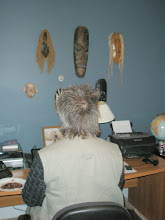
The point here - if you're still at all curious as to whether I'll ever get to a cogent point - is that I love the knowledge that we are people heading in the same direction but on different paths and sometimes wildly different paths.  This is the whole key to spiritual growth and spiritual growth is the whole key to a contented, grateful sobriety.  Since Special and I are both older and retired we have the luxury of getting up early and having an extended Quiet Time.  He lives not far from me and I occasionally receive an image of him on his Serenity Couch and me in my Serenity Chair, both of us trying to maintain a happy level of peace and contentment.  I'm not sure what his set-up is but it works for him.  I'm in a comfortable room with lots of windows where I can see the dawn break and experience the magic of the gradually changing light.  My chair is comfortable and I have a heating pad to soothe my aging back.  There's a pile of books near me - spiritual and meditation books - and, in fact, the whole room is filled with books, lined with books, books spilling into the other rooms, dimly perceived in the dim darkness  . . . which makes me happy because I love to read.  My spirituality oozes from these books.  And the walls of my room have a lot of knick knacks and tchotchkes from our travels.  I am curiously drawn to masks and heads so I have a ton of faces looking back at me stoically, probably judging me and finding my performance lacking, but they bring back memories from my journeys, traveling being another huge, huge joy in my life.  I have music going, too - not every day but often - meditative, ambient music from all over the globe and on the days when I prefer some sound to the quiet of the room I suck a lot of good energy from the tunes.

So I've gone over the years from this church God, this dress-up-and-pray-specific-prayers-god to a room of books and art and music.  I think my buddy has a dog that may or may not join him in his Quiet Time.  When our cat was alive that heat-seeking missile would often hop up on my lap and purr, sucking the tiny amount of extra heat that I generate out of my body.  Animals are a great representation of God, too.


Thursday, March 5, 2026

Big Clangs and Dull Thuds

There's a guy who comes to Keep It Complicated who has put together a couple of years of continuous sobriety.  I like him just fine but I find his behavior somewhat off-putting from time to time.  He's got a sharp mind and a quick wit, and he's got a good heart.  What I find jarring sometimes is his timing when he interacts with other people.  His behavior is not bad, it just doesn't land kindly all the time.  Perhaps I should talk about myself to make this more clear: I have a dry sense of  humor and a mildly skewed way of looking at the world.  When I was getting sober I tried way too hard to be funny and way, way hard to be off beat and the result was often .  .  .  oddly unpleasant.  It wasn't the words - it was the timing and the context. It often didn't work.  My attempt to be funny landed with a thud.  I can say to  Willie "Man, you are an idiot" and he'll roar with laughter.   My timing is good, I have a history with the man, I'm not going to say this at an inappropriate time when he may be hurting.  The words sound harsh but the effect is positive.  It's affectionate.  Put it down on a piece of paper and provide no context and it sounds awful.  For example: I don't really find smutty, suggestive humor humorous.  I'm not saying it isn't humorous - just that it isn't funny  to me.  It wouldn't take an Olympian amount of perception to pick up on the fact that I'm not enamored with this kind of joking around but my friend is not picking it up at all.  I suppose I could tell him to knock it off but that's not really my style.  I'm not comfortable suggesting that someone else should change or how that change should look - I'd prefer that they change all on their own and only if they feel like changing.  After all, it's not my call how he should behave.  Moreover, most alcoholics don't like to be criticized or prodded into behavior that they haven't decided is in their best interests.  I like to think I get to take credit when things go my way and I get to take the blame when they don't.  My sponsor for many years would laugh on the rare occasions I asked for advice: "Oh, no you don't," he'd chortle.  "If it doesn't work out I don't want to hear about it."   

Here's an example: I shared a story about a conversation I had with the young woman who was cutting my hair about addiction and recovery.  I do this all the time - I'm far past the point of caring what anyone thinks about drugs and alcohol.  It turns out she has some issues with drinking, too, and has actually been to rehab - amazing how often I get an identifying response when I talk about my recovery life - so I invited her to join me at the Keep It Complicated collection of knuckleheads and ne'er-do-wells, and offered to introduce her to some of the younger women who attend.  My buddy came up afterwards and quipped about me being a dirty old man and he knew what I was up to.  I get that he was trying to be funny and that some other people would think this is funny or that under the right circumstances even I would think it was funny but in this instance it landed with a hollow thud, a big clang.  I know that I have a gentle, non-threatening way with younger men and women and that my style is more suited to girls than to boys.  I get depression and guilt and shame better than I get anger and aggression and rowdy defiance.  I wasn't at all offended at my buddy's ill-timed and poorly-delivered jabs - I got it that he was trying to be funny - because I understood that this was about him and not about me.  This is how he might have been tempted to behave in a similar situation so he transferred his intent onto me.  This would have been a good time to compliment me on my efforts to steer someone suffering into a recovery program instead of suggesting some kind of predatory intention.   

I still like the guy.  I think he's really changing.  I bet he gets to a kinder, more perceptive place.  But I hope that he retains his own personal Anthony-ness because this is what makes him genuine.  We're able to build real connections with other people by being who we are all of the time.
             

Wednesday, March 4, 2026

The Plain Language Big Book

From Bill's Story as repurposed in the Plain Language Big Book: "It was a relief to know that most alcoholics have a hard time resisting drinking, even if they are able to control themselves in other parts of their lives.  This helped me understand my actions.  I wanted very badly to stop drinking, but it seemed like I just couldn't.  This is how most alcoholics felt."

In the history of the Christian religion for centuries mass was conducted entirely in Latin.  Great - preaching to an audience who didn't know how to read in a language they couldn't understand.  Good technique.  Makes perfect sense to me.  Then, the Bible was translated into English in an old-timey fashion - The King James' Version - so if you could read you didn't mind a lot of thou-s and thee-s and shalt-s and so on and so forth.  Again, very logical.  Why say "Don't do this" when you can say "Thou shalt not do this."  That's how most people are going to talk as they go through their day.  "Thou shalt not eat that cookie before dinner" and "Thou shalt brush thy teeth after eating that cookie I told thee not to eat."  And so on and so forth.

The uproar!  The outrage!  The apostasy!  We might as well be watching a partisan cable news show - or should I say "news" show? -  excoriate The Other Side.

So far I'm finding it to be very inoffensive.  It's almost as if someone asked me or any other A.A. member to summarize Bill's Story.  The words might be a little different, a little more modern, but the message doesn't waver.  The Daily Reflections - approved A.A. literature - is nothing more than ordinary people interpreting a literature passage in their own words.  Most of them I like or find blandly neutral and a few I don't care for.  So what?  I'm not a ten year old.  I can take what I like and leave the rest.


In the MOMENT

I was waiting for my overpriced specialty coffee drink on Saturday and watching a young couple and their daughter, who was just learning to walk.  Dad was holding her arms and helping her along.  She looked damned serious.  "Okay, apparently I gotta do this so let's get to work."  The parents sat down and the child hung around for a second before deciding to strike off on her own.  She took a couple of unsteady steps so I sidled over and blocked her path to help Dad out as he got up to make sure she didn't wander too far.  She stopped, craned her head way back and tried to make sense of this huge skyscraper that was now in her way, and then broke out into the biggest smile I have ever seen and just plopped down on her bottom and continued to look up at me, smiling away.  I could see how in the moment she was.  I could hear her mind working away: "I was walking which was hard but pretty fun and now this is going on so I'm going to take a beat and see what's what."  The walking was gone.  She was done walking.  She probably didn't even remember walking.  It was time to check out the skyscraper and that had her full attention.   

Tuesday, March 3, 2026

Penguin Doodling

I have a spot for my Quiet Time - a comfortable chair with books stacked around me, my journal, a candle burning, a mood light that I bought in China - a small rectangular tower with translucent red panels decorated with dragons that glow when the lamp is turned on - and lots of windows.  It's the time of the year where it's still dark when I begin my meditation and I get to experience the world as it slowly brightens.  It's really quite amazing watching how the light changes and how this is influenced by the cloud cover and the seasonal angle of the sun.  I think this is God as a deliberate, anal-retentive, careful engineer type.  This took some planning.  This was not getting high and building a penguin.  God did that in like five minutes, laughing his ass off the whole time.  The sky was an engineering task - the penguin was a doodle on the back of a cocktail napkin at a dive bar at 2 AM.

When I'm with other people I hope I'm tossing good energy out into the universe, flinging it into the mix, and that the universe improves because of this.  Is this God getting involved?  Or is this just the good thoughts and the good energy working away, chipping away the bad juju and brightening the sky?  I dunno anymore.  I believe that when I think of other people instead of obsessing over every tiny speck and bit of minutia in my own life that I vibrate some positivity outward and that everyone is the better for it.  I understand that my little bit of vibration enhancement is pretty pathetic all alone but it's all I'm responsible for and all I can do.  If other people vibrate positivity the world gets better.  That's my belief.  But I can't dictate the terms for anyone else.  Chase after your own wishes or desires or live in a life of service or - like most of us - fall somewhere in between.  Plus, not thinking about myself is so good for my mental health.  It's exhausting thinking about myself as much as I do.   

You get to make the call.   

The Lake of Fire

So we bought a new car to replace SuperK's ten year old model.  Just to be clear and upfront this is obviously going to be one of those stories where I bitch about a high-end problem.  Although now that I think about it that's really all I bitch about at this point on the new model.  Since we don't drive a lot we normally buy a slightly used car but we splurged this time.  If you've never had a new car it's a pretty cool experience as you get to drive around inhaling that great new car smell - which is actually toxic volatile chemicals off gassing from all the plastic in the interior - and wondering where the money is going to come from to pay for this extravagance that you spent a lot of money on and all it did was replace a perfectly good low mileage, dependable, used car.

We went to lunch yesterday and came back to the car to discover someone had backed into it and then drove off without leaving a note.  They almost backed directly into the temporary paper license plate affixed to the rear panel.  It looked like they were aiming for the temporary license plate.  I ascribed all kinds of malevolent intent to this incident.  Someone did this to me on purpose.  To me.  They weren't going to hit anyone's car until they saw it was my car which caused them to fly off into a murderous rage.  Intellectually I realize that someone was probably frightened by the damage and fled, maybe someone with little money and poor insurance, the fear overriding their internal sense of ethics, of right and wrong.  Boy, I know all about that.  While I understand that stuff like this can happen but how about giving me a fucking week before you damage my car?  But because I'm a kind, loving, understanding spiritual spirit guide I decided to downgrade my curse on this individual: I merely hope that they burn for all eternity on a Lake of Fire even though this category of transgression would permit me to toss in a devil or demon or two or three whose sole purpose would be to stick white hot needles into the genitals of the transgressor who is already burning for all eternity on a Lake of Fire.  Clearly, in my mind, the Lake of Fire treatment isn't quite harsh enough.  Granted, it does sound pretty awful but isn't it a passive kind of torture - you toss someone in the Lake of Fire and then you walk away?  How about some active, hands-on torture where the torturer can assess the situation and add additional torture if the Lake isn't causing enough suffering?  Relying on the Lake of Fire and the Lake of Fire only sounds kind of devil-lazy.  It's roughly akin to comparing a passive index mutual fund with an actively managed mutual fund.  Granted, the passive variety generally performs better but there's some comfort in knowing that someone is manipulating your money.  I say get some eyes-on-the-ground to amp up the torture when necessary.  Personally, I like hot weather so a Lake of Fire might not be as effective on me as it would be on SuperK who hates hot weather.  Tossing me into a big tub of ice water for all eternity actually sounds worse in my case.

There's a Simpson's episode where the whole family has been sentenced to hell and Grandpa is shown sitting smack dab in the middle of a big bonfire complaining that "I'm STILL cold."  That would be me.  I'd nudge the rheostat on the Lake of Fire to turn the heat up a little more.

While this flight of fancy is all kind of fun and hallucinatory the real message is that we're both okay emotionally, more or less.  I wish it hadn't happened and it's going to be a pain in the ass to remedy but I do have insurance and there are good body shops that can repair this minor damage and even if they couldn't/can't it's not like the car - the very nice car, very luxurious car - can't be driven.  A note.  A note would have been nice.  But as we worked through our emotions we did admit to the possibility that maybe the driver doesn't have insurance and doesn't have much money and was terrified at the consequences.  While this doesn't make it right it does add some perspective and perhaps make it more understandable.

Sunday, March 1, 2026

Again With the Gratitude List

I bring up the fact that as a naturally ungrateful person, a person who sees the problem much  more clearly than the solution, who is wary and suspicious and guarded by nature, that I find it salutary to manually go through a Gratitude List every morning.  I maintain that this worldview is pretty common - life is hard and if I see a bear behind every tree then it's not likely I'm going to get eaten by a bear - so for many of us it is a great coping skill.   I also acknowledge that there are indeed some freaks of nature out there who are naturally grateful.  I suggest that these are the people we should worry about and not pissy, irritable people like myself.  

Anyway, the first pieces of my list and the pieces that absolutely dominate the list all revolve around people and my relationships and how incredibly, incredibly blessed I am to have so many wonderful people in my life.  Then, at the very end, I express gratitude for my stuff - two nice cars, a lovely  house, enough money in the bank that I don't have to worry about an unexpected expense.  Here's where it gets weird and deliciously ironic: when I first stumbled into The Rooms the ass-end of my list was always migrating up to the front.  Money!  Power!!  Sex!!!  Gratitude for the direction given me by my long-dead grandparents?  Gratitude for teachers who were patient and wise when I was a pre-teen?  I did not think this way.  Pressed I would have said I was grateful for them but I didn't express this gratitude in my daily life.  I was too consumed with pursuit for the almighty dollar and other shallow and ultimately unsatisfactory things.

Saturday, February 28, 2026

Who's The Real Idiot?

There's a guy that has been a regular at my meeting since he got sober.  He was an angry guy.  He was so angry that he was tagged by some of our more sarcastic members with the sobriquet "Angry Chris" which - of course - pissed him off.  He's been coming to meetings for seven or eight years and he has gotten a lot less angry and watching these kinds of transformations are one of the great joys of my life.  If someone doesn't use a turn signal in front of him his old reptile brain still brands that driver as an idiot - that's his essential Chris-ness - but it doesn't make him mad anymore . . .  or not as mad anyway.  I love seeing people change without losing touch with the kind of person they are.  He's still Chris but he's "Fun Angry Chris" now.

I think of my own growth in The Program.  I've always had what I call a dry sense of humor and it no longer irritates me when someone suggests instead that I'm sorta a sarcastic pain in the ass because there's probably some truth in that.  That's my essential Seaweed-ness.  If I didn't have a dry sense of humor I wouldn't be me and most of the time I like me just fine.  But what I needed to do was to learn how to make this dryness playful and kind and not cutting and judgemental.  I bet if you heard newly sober Seaweed say the same thing to the same person - the exact same words - that thirty-eight year sober Seaweed would say you'd cringe at the old Seaweed and laugh with the new Seaweed.  Same words - different effect.  Something would be off with the impact of the old Seaweed.  You'd wince a bit.

I feel like what I've been able to do over the years is to rub off the rough edges of the old Seaweed and add some putty and bondo to the underdeveloped parts and come up with a new and improved Seaweed.  Funny and kind Seaweed instead of arrogant and unkind Seaweed.  That's the improvement.  But as weird as it sounds I still retain some of my arrogance and judgemental nature.  That's the essential, the authentic Seaweed.  I still think I'm better than everyone else and I still think everyone else is an idiot.  I think you're an idiot and I don't even know who you are.

The good thing is that I DO know who the REAL idiot is.

Thursday, February 26, 2026

My God Uses Drugs Responsibly

My God is a casual drug user.  He's God so he doesn't have a problem with drugs.  I mean . . . he made the drugs so he's really dialed into what's okay and what isn't.  He is quick to point out that some drugs are crappy and dangerous - fentanyl and methamphetamine come to mind - and that not everyone can tolerate a little recreational drug use but he's good with his routine.  He can take it or leave it.  Some weed to get the creative juices flowing and an occasional hit of LSD to weird things out - that kind of drug use.  I've come to this conclusion after many hours pondering the magnificence of our natural world and the stuff in it.  For instance, I think God had a lot of no-nonsense hard-working days when he made trees and dogs and salmon and then there were the down days where he was tripping a little bit and he built penguins and kangaroos and flying fish.  There is a family of owls living in the barranca near my house and they spend some time hooting at me.  God was definitely a little stoned when he came up with that.  Songbirds singing lovely lyrical songs make sense - some weirdo night bird hooting . . . that's evidence of some good weed, that is.  

Wednesday, February 25, 2026

Who Are You Again?

In the Doctor's Opinion the good doctor relates an incident where a former patient walked into his office after some sober time in our brand spanking new Twelve Step Program and was so changed that he was virtually unrecognizable.  The doctor sensed that he had known this man but couldn't make the jump from the trembling, destroyed alcoholic who first entered his office to someone full of the joy of life, self-confident and relaxed.  I've looked at the occasional picture of myself at the end of my drinking life.  I don't do it too often because it's an unpleasant experience.  Qualifiers like "Undateable" and "Unemployable" come to mind.  I thought I was fooling people, pulling the wool over their eyes as to the kind of life I was living?  Holy Moly, mother of god I was fooling precisely no one.

I had been sober for a little while and was visiting my family in sincity when I ran into the mother of one of my best friends while walking through a local shopping mall.  I strode over, big smile on my face, happy to see her, a mama who had always been kind to me and a favorite of mine, and was perplexed to see a confused look on her face.  She did not recognize me.  I had to introduce myself.  I'm sure I thought that she was deep into dementia or had cataracts occluding her eyesight because who in the hell could forget me?  I recall being mildly offended.  "Boy, I must have made a big impact on her."  That kind of thinking.  Today I understand that we change as we get healthy.  We look different, so different that people don't recognize us immediately or they don't recognize us at all.

Tension and stress and fear and anxiety are written large on our faces.  The damage caused by smoking and using and drinking and not getting enough sleep and eating like shit show on our faces.  I guess the destruction is so slow-motion that we don't pick up on the changes.  Boy, aren't you glad you're sober?

Tuesday, February 24, 2026

Here Comes the Crud

I think a lot about gratitude and how surprising a concept it can be.  How often I'm not as grateful as I should be for the mundane, taken-for-granted blessings in my life.  This doesn't make me a bad person.  In fact, I think that it makes me pretty average.  Life is not easy and we're often fending off difficulties and challenges, not contemplating our navels, marveling at how good we have it.  An apt reminder for me is to be grateful that I'm in very good health.  I usually take this blessing as something that I've earned or that is my due.  I'm one of those people who kind of gets whatever crud is circulating through a community.  I get an average number of colds or respiratory illnesses.  I'm not sick all the time but I do get sick.  Many years ago - 2004, to be precise, demonstrating how transformative this experience was - I contracted a stubborn chest cold that hung in there for quite a while.  As I was just rounding back into health I got the flu - I've had the flu twice in my life that I can remember so another transformative experience - and was as sick as a dog for a few weeks.  I believe that because my body was so worn down fighting off crud that in my run-down, weakened  state I was vulnerable enough to get another cold.  I recall getting sick, being sick, and recovering from being sick for a solid two months.  Then, one day, I was shocked to realize I felt healthy.  I was blown away by how healthy I felt. I was immensely grateful that I simply wasn't sick.  I didn't win the lottery or anything - I just wasn't sick.  I was struck by the realization that I express very little gratitude for all of the days and weeks and months that I'm in good health and fine fettle.  I remember saying: "Goddamn I feel good" while realizing that I feel this way almost all of the time and totally take it for granted.